

CoREST KMGDs
LeadFirst-in-class molecular glue degraders
MPNs · AML · Thymic rejuvenation
Established in vivo PoC; advancing toward development candidate selection.
ProgressLead Optimization
DiscoveryLead Opt.IND-EnablingPhase 1/2
RejuvenRx leverages world-leading expertise in stem cell biology to develop disease-modifying medicines in hematology, oncology and aging — with first-in-class CoREST molecular glue degraders and an initial focus on myeloproliferative neoplasms and thymic rejuvenation.
Founded in 2020 by Prof. Guy Sauvageau & Anne Marinier, Université de Montréal

The dysregulation of hematopoietic stem cells sits at the root of myeloproliferative neoplasms and the erosion of immune function with age. Existing options fall short of modifying the underlying disease.
For myeloproliferative neoplasms, allogeneic stem cell transplantation is the only curative option — with limited applicability. Current therapies manage symptoms with minimal impact on disease progression.
Thymic involution erodes immune competence, leaving patients vulnerable after hematopoietic cell transplantation and in age-related immune decline. No approved therapy restores it.
MPNs affect approximately 300,000 individuals in the US alone, with roughly 12,000 new cases each year — a large population with insufficient long-term control.
By degrading the CoREST complex, our molecular glues rejuvenate the blood system — reprogramming primitive myeloid progenitors and unlocking disease-modifying potential that enzymatic inhibition alone cannot reach.
Our approach targets the CoREST complex — the epigenetic hub governing blood stem cells — through molecular glue degradation validated across peer-reviewed research and the clinic.
The Target
The CoREST complex (RCOR1/3, LSD1 and HDAC1/2) is a central epigenetic regulator that controls hematopoietic stem cell self-renewal, lineage commitment and differentiation through coordinated histone demethylation and deacetylation. Research from the Sauvageau laboratory has revealed that aged hematopoietic stem cells display a profoundly altered CoREST1 transcriptional and chromatin accessibility signature compared with young stem cells (see deep dive), identifying CoREST as a key driver of stem cell aging and a compelling therapeutic target.
The Mechanism
UM171 — discovered in the Sauvageau and Marinier labs — is a context-dependent, KBTBD4-recruiting degrader that removes CoREST subunits only within the complex, confirmed by cryo-EM. It is the proof of mechanism for our program.
KBTBD4 Molecular Glue Degraders are referred to as KMGD.
The Difference
LSD1 inhibitors validate the biology but enzymatic-only inhibition leaves room to improve. KMGDs offer superior selectivity, context-dependency and reversibility for a wider therapeutic window.
Unlike catalytic LSD1 inhibitors, which inhibit LSD1 activity irrespective of its binding partners and consequently perturb multiple LSD1-dependent regulatory complexes, CoREST degraders selectively dismantle the RCOR1–LSD1–HDAC complex. This approach abolishes both the enzymatic and scaffolding functions of LSD1 specifically within CoREST while preserving LSD1 functions in non-CoREST complexes, including NuRD and nuclear receptor-associated transcriptional programs. By targeting a discrete epigenetic repressor complex rather than the enzyme itself, CoREST degradation is predicted to achieve more selective chromatin remodeling with an improved therapeutic index.
UM171 — the prototype
Proof of concept, not bioavailable
UM171 was the first-generation CoREST degrader and proof of mechanism — but it is not orally bioavailable, so it can only be used ex vivo to expand cord-blood stem cells in a dish. That mechanism underpins Zemcelpro® (EU-approved) and is licensed to ExCellThera. RejuvenRx does not develop the ex vivo asset.
KMGDs — in vivo
Developed at RejuvenRx
New, orally bioavailable CoREST degraders dosed systemically to treat patients directly — advanced with academic labs. A distinct chemical class, not the ex vivo molecule.
Thymus rejuvenation with CoREST degraders
CoREST degraders restore the immune shield by rejuvenating thymic function and re-establishing healthy T-cell production. Two complementary modalities share this biology: UM171, the ex vivo cell-therapy leader that drives rapid immune reconstitution, enhanced TCR diversity and restored immune tolerance in transplant settings; and UM626, an orally bioavailable analog that delivers in situ thymic rejuvenation without complex cell manufacturing — extending the approach to aging, immunosenescence and autoimmunity through simple, non-invasive dosing.
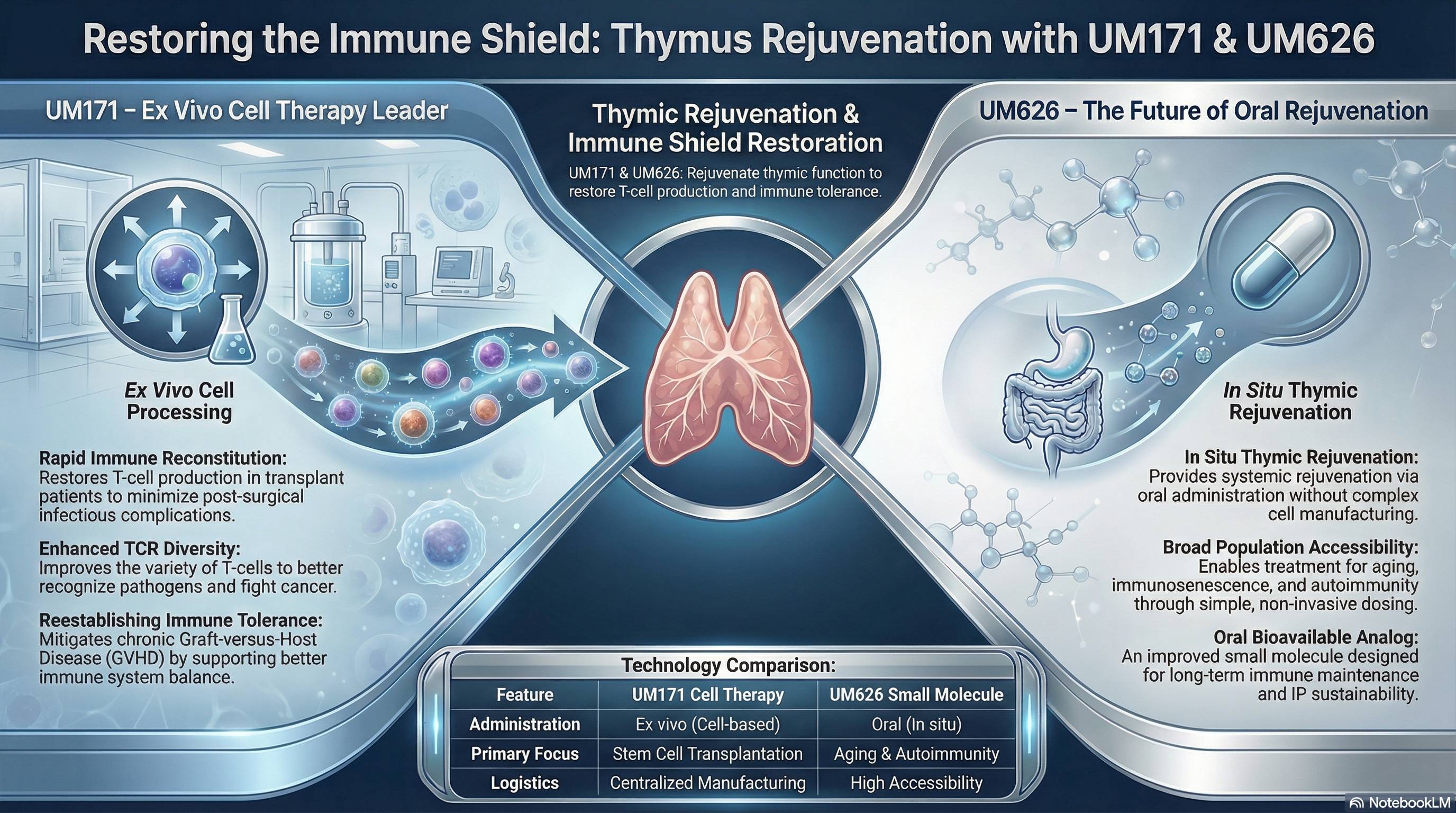
UM171 — ex vivo cell therapy
UM626 — oral in situ rejuvenation

![3D ball-and-stick molecular model of UM171, a pyrimido[4,5-b]indole with benzyl, methyltetrazole and aminophenyl-amino substituents](/images/um171-3d.png)
UM171 is the non-bioavailable prototype of CoREST degraders discovered by our academic founders.
Deep Dive
This section contains confidential scientific detail. Enter the access password to view it.
Our CoREST program anchors the pipeline while the molecular glue platform extends into additional oncology targets sharing the same chemistry and mechanism.
First-in-class molecular glue degraders
MPNs · AML · Thymic rejuvenation
Established in vivo PoC; advancing toward development candidate selection.
Best-in-class molecular glue degrader
Triple-negative breast cancer (TNBC)
Differentiated degrader series expanding the platform into solid tumors.
OXPHOS / cancer metabolism
Pancreatic cancer
Differentiated modulators of oxidative phosphorylation and cancer metabolism.
Our lead CoREST degrader program targets a fundamental CoREST-dependent epigenetic mechanism that drives both stem cell aging and myeloproliferation. By selectively dismantling the CoREST complex and restoring healthy epigenetic regulation, a single biological mechanism supports two therapeutic opportunities: hematologic malignancies (AML and myeloproliferative neoplasms) and immune rejuvenation through restoration of thymic function.
Restoring immune competence lost after transplantation and during aging by rejuvenating the lymphoid potential of aged hematopoietic stem cells that seed the thymus, rather than by targeting the thymic microenvironment itself. In contrast to therapies that rejuvenate the thymic epithelium ("soil"), KBTBD4 molecular glue degraders (KMGDs) rejuvenate the hematopoietic stem cell "seed," restoring the production of lymphoid progenitors capable of repopulating the thymus. Exploratory Phase 0 endpoints — including T-cell receptor excision circles (TRECs), CD4+ T-cell counts, TCR repertoire diversity, and total lymphocyte counts — will establish early biomarkers of biological activity and guide subsequent clinical development.
A lead program targeting PV, ET and myelofibrosis — where no curative drug exists. With established in vivo proof-of-concept, our oral CoREST degrader aims for rapid disease-modifying clinical signal, initially in post-JAK2 patients across a $3B+ addressable market.
A focused lead asset delivers near-term value while a scalable platform opens significant upside across hematology, oncology and aging.
$3B+ TAM
$3B+ TAM
New Market Creation
A team of scientists and operators who discovered UM171 and have spent decades translating stem cell biology into medicines.

President of the Board
Executive leader with broad experience guiding life sciences organizations through strategy, growth and governance.

CEO & Board Member
Over 25 years in drug discovery and development. Co-founded and led IRIC’s Drug Discovery Unit and identified UM171.

CSO & Board Member
Internationally recognized stem cell biologist and hematologist. Identified UM171 and co-founded IRIC and the Quebec Leukemic Cell Bank.

CFO
25+ years of expertise across business strategy, operations, corporate finance and financial markets.
Board Member
Over 20 years of business management and advisory experience in life sciences — financial, legal and strategic.

Advisor
Over 20 years in oncology R&D and BD. Previously CSO at Infinity Pharmaceuticals and Global Head of Oncology External Innovation at Ipsen Bioscience.

Professor, McGill University & Université de Montréal
Expert in neurobiology.

Professor of Medicine, Université de Montréal
Expert in myeloproliferative disorders and clonality studies, including TCR, BCR and hematopoietic stem cells.

Assistant Professor of Medicine, Université de Montréal
Expert in clinical trials for myeloproliferative neoplasms (MPN).
RejuvenRx is raising a $5M seed round to advance our lead CoREST program to development candidate selection within 6–12 months, operating on a lean, milestone-driven model.
Built on clinically validated UM171 / CoREST biology, with in vivo proofs-of-concept in HSC expansion and an AML model.
Proprietary, orally bioavailable KBTBD4 molecular glue degraders (KMGDs) — a differentiated mechanism beyond LSD1 inhibition.
A $3B+ near-term opportunity in MPNs, with platform upside across hematologic malignancies, oncology and aging biology.
Founded by the discoverers of UM171, supported by an experienced board and a specialist scientific advisory board.
Use of proceeds
Development candidate selection
Advance CoREST KMGDs to DC nomination
IND-enabling studies
Initiate tox and CMC readiness
Platform expansion
Progress Cyclin K and ETC1 programs
Recent announcements and coverage of RejuvenRx and our CoREST degrader platform.
The Stem Cell Network announced its first-ever direct biotech investment — a $1 million award to Montreal-based RejuvenRx to advance its CoREST molecular glue degrader platform.
RejuvenRx is seeking a $5M seed investment or strategic partnership to advance the CoREST program to development candidate selection within 6–12 months, with a lean operating model aligned to IND-stage biotech execution.
We welcome conversations with investors, strategic partners and clinical collaborators who share our mission of adding life to years and years to life.